

Does Photonic Layer Security Add Latency or Distance Limits to a Fiber Link?
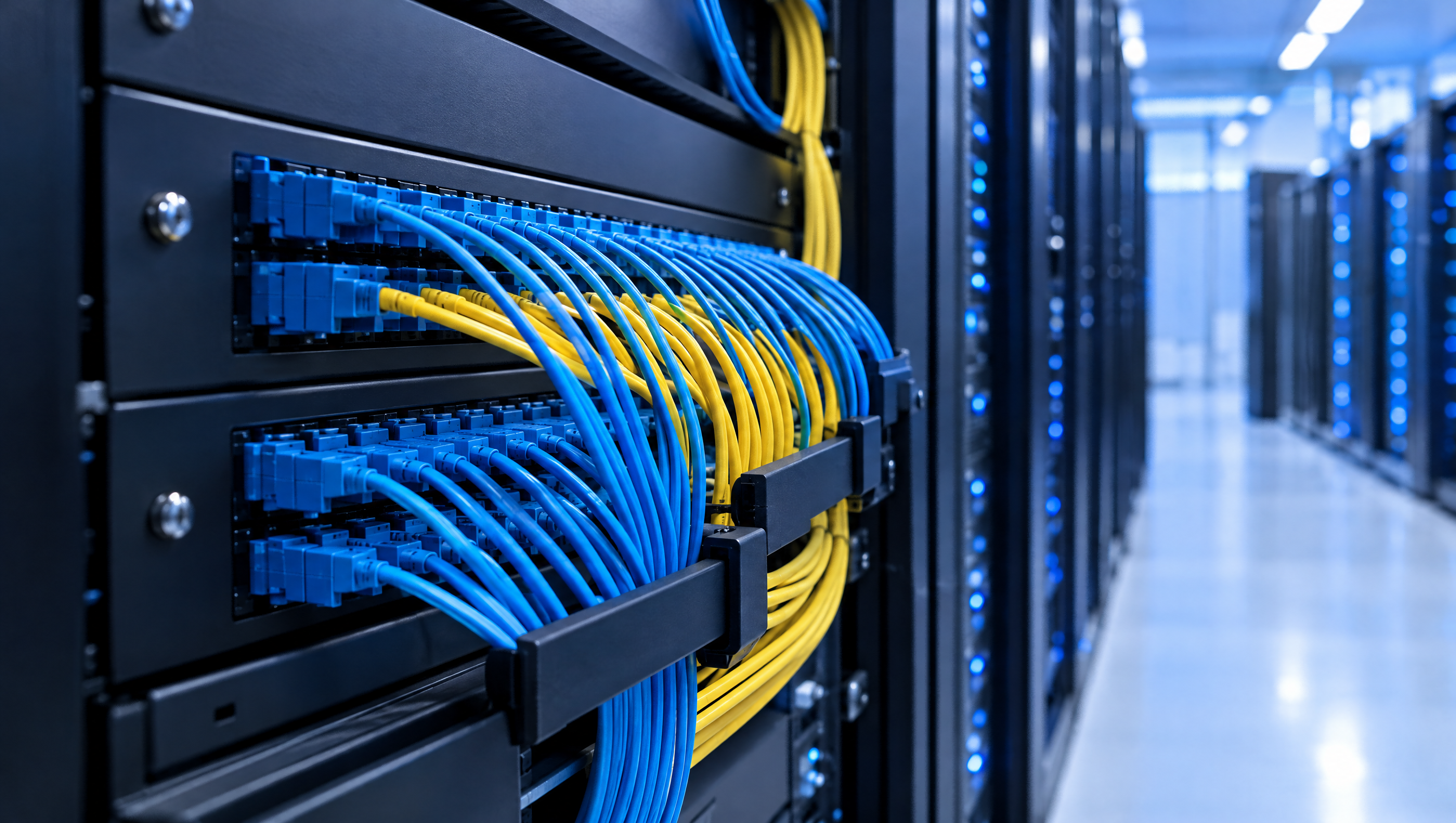
Photonic layer security adds no additional latency, so the fiber itself sets link delay at about 5 microseconds per kilometer. On reach, a Carmel link runs up to 100 km without amplification and is compatible with EDFA and Raman amplifiers for longer spans. Quantum key distribution is more limited: it reaches roughly 50 to 100 km without trusted relay nodes, because photon signals cannot be amplified.
Photonic layer security adds no additional latency, and it carries a reach of 100 km per unamplified link. Over a 100 km span, the fiber alone adds about 500 microseconds of one-way delay, with or without a security layer. Carmel is fully compatible with EDFA and Raman amplifiers, so longer routes use the amplifiers that conventional links already use. The sections below show how each figure was reached and where it stops.
Factors contributing to latency
Carmel adds nothing to the delay of a link. The delay comes from the physics of the fiber, and it grows with distance. CommScope puts the delay at 5 microseconds per kilometer, because light travels about 1.5 times slower in fiber than in a vacuum. A 100 km span therefore has about 500 microseconds of one-way delay, and an 80 km span about 400 microseconds, with or without Carmel. Every switch, router, and transponder in the path adds delay on top of that, and packet-layer encryption is one of those hops: a 2018 multilayer network study names complexity and added latency as the main drawbacks of IPsec. Carmel is not one of those hops, so a link with Carmel has no bearing on the delay.
How Carmel compares with Layer 1 and packet-layer tools
Security tools add delay where they process data. Layer 1 hardware adds nanoseconds where packet-layer tools add microseconds or more. In a 2014 GCN column, Uli Schlegel of ADVA Optical Networking wrote that 100 Gb/s networking with Layer 1 encryption adds less than 150 nanoseconds of latency. At 5 nanoseconds per meter of fiber, 150 nanoseconds equals the delay of about 30 meters of cable, or 0.03 percent of the fiber delay on a 100 km span.
Carmel adds no additional latency because processing happens in the optical domain with no packet overhead. Carmel spreads the signal across 1-2 terahertz of the C-band and applies optical keys that change continuously, and both steps act on the light itself. A buyer who needs a measured value for a specific path can request one in a proof of concept.
For more on how the two approaches differ, see What Is Photonic Layer Security, and How Is It Different from Optical Encryption?
Reach: 80 km demonstrated, 100 km unamplified
A 2025 Journal of Lightwave Technology paper, co-authored by our founders, established a 100 Gbps DP-QPSK signal over 80 km of standard single-mode fiber. Our project record in the EU’s CORDIS database describes Carmel links of 80 to 100 km, and Carmel supports up to 100 km unamplified. These figures agree on the same band for a single span, so an 80 to 100 km hop is the planning unit for a Carmel link.
Longer routes require amplifiers. Carmel is compatible with EDFA and Raman amplification, with no maximum amplified distance specified, and deployments have been validated at 150 km on a live carrier link and 200 km on production networks. The total length of a route is therefore a design-phase question for engineers, with the span count and amplifier placement as variable inputs.
Quantum key distribution faces a harder ceiling. A 2025 arXiv survey of enterprise quantum-safe readiness puts fiber QKD at roughly 50 to 100 km without a trusted relay node, because amplifiers would disturb the photon states. A photonic layer security link keeps ordinary amplification, so route length is planned with standard optical engineering.
Carmel link parameters for planning
The table collects the figures that matter when sizing a link.
Here’s how CyberRidge delivers unrecordable high-speed optical transmission and how it is deployed.
Measuring latency and reach on a candidate link
A proof of concept confirms both figures on one path. Operators can compare round-trip delay on the candidate link before and after installation, and the two results should match, since the fiber delay is identical in both runs. Span length, loss, and amplifier positions are the inputs to confirm with engineers, since the amplified maximum is worked out at the design stage. Inter-datacenter replication and other latency-sensitive links make the most informative test cases.
From the point of installation, Carmel protects traffic from that point onwards. Those scope limits sit alongside the latency and reach figures when a link is selected.
Planning a link where delay and reach must be proven first? Visit CyberRidge to discuss a proof of concept.
FAQs
Q: Does photonic layer security add latency to a fiber link?
A: No. Carmel adds no additional latency. Carmel replaces the line card in the transport path and adds no latency compared with the line card it replaces. The remaining delay is set by the fiber, at about 5 microseconds per kilometer, and it is the same with or without Carmel. A 100 km link carries about 500 microseconds one way either way. A proof of concept gives a measured value for a specific path.
Q: What is the maximum distance for a Carmel link?
A: Carmel supports up to 100 km without amplification. Carmel is compatible with EDFA and Raman amplifiers for longer spans, and no maximum amplified distance is stated.
Q: How does Carmel’s latency compare with MACsec and IPsec?
A: ADVA Optical Networking states that MACsec and IPsec produce significantly higher latency than Layer 1 encryption, and it measures Layer 1 encryption in nanoseconds. Carmel adds no additional latency. A side-by-side test on the same path is the reliable way to compare the three.
Q: Does Carmel work with optical amplifiers?
A: Yes. Carmel is fully compatible with EDFA and Raman amplification. Quantum key distribution cannot use amplifiers, so it stays within roughly 50 to 100 km without trusted relay nodes.
Q: What line rate does Carmel support?
A: Carmel runs at 100 - 400 Gb/s per link today, with a standard 100 GbE client connection.
Q: How can an operator confirm latency and reach on its own network?
A: A proof of concept on the candidate link measures both. The operator compares round-trip delay before and after installation and confirms span length, loss, and amplifier positions with our engineers.