

Can Fiber Optic Cables Be Tapped, and How Do Enterprises Detect It?
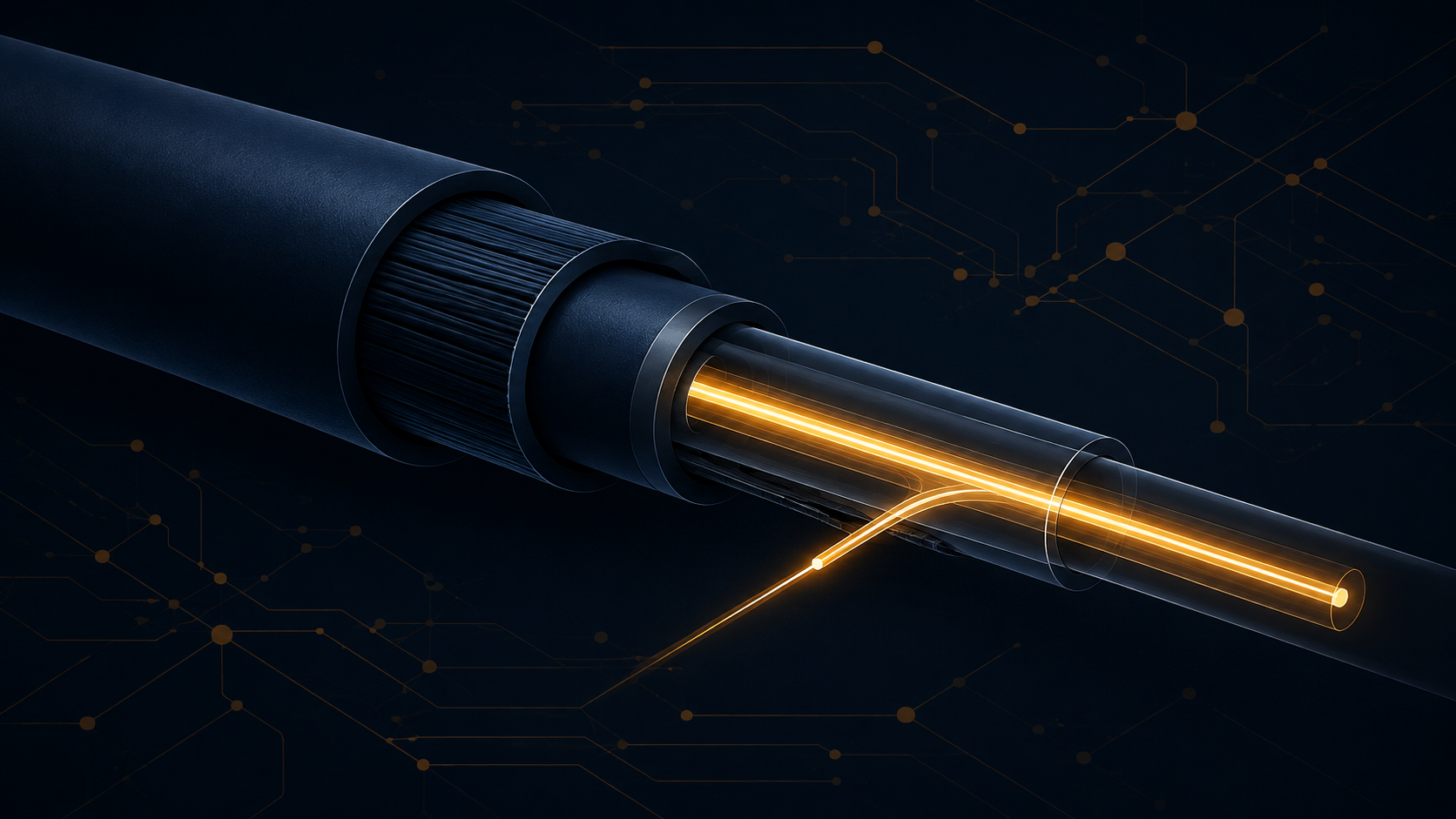
A fiber optic cable can be tapped without cutting it or causing an outage. A bend or coupler tap extracts a portion of the light while the primary signal keeps flowing normally. Junction boxes, cabinets, and manholes are the weakest links in most fiber networks. Optical time-domain reflectometry (OTDR) testing, power monitoring, and physical security are the main detection methods used today, each with limits. Photonic-layer security, the approach behind CyberRidge's Carmel platform, closes that gap by making a tapped signal worthless to an interceptor.
Yes, fiber can be tapped, and a well-executed tap doesn't disrupt the signal enough to trigger an alarm on its own. Because the interception happens at the physical layer, it falls outside what most digital security monitoring is built to catch, which is why fiber taps have a long track record in both corporate espionage and state-level surveillance operations.
What is fiber optic tapping?
Fiber tapping means physically accessing a fiber and diverting a tiny fraction of its light to a separate receiver, without stopping the original signal. Interception happens at the physical layer, before any digital processing. A passive tap only needs a small amount of its light, so the signal barely dips, leaving no login attempt or alert to flag.
A tap doesn't need much light to work. Commercial splitters used for legitimate network monitoring are commonly built in ratios like 70/30 or 90/10, and an attacker can use the same off-the-shelf components. Even a 1-2% split is enough for a sensitive photodetector to reconstruct a readable signal, and some documented taps have used far smaller splits, while the remaining 98-99% continues on to the intended receiver largely unaffected. That asymmetry is what makes passive taps hard to catch through traffic behavior alone: the network keeps functioning normally on both ends while a full copy of the data quietly leaves through a second path.
How a fiber tap physically works
A tap bends bare fiber past its minimum bend radius so light escapes the cladding for a clamped photodetector to read. A coupler or splitter tap works differently. It splices a small optical component directly into the fiber, which diverts a fixed percentage of the light down an alternative fiber to the attacker's receiver. Taps usually target the weakest physical points. Splice cabinets, manholes, and junction boxes are easier to access than a buried span, and are recurring soft targets. Standard encryption prevents the deciphering of tapped data by standard computing capabilities, but it doesn't stop the tap, or the harvesting of the stream for later decryption once quantum computing can break the key exchange protecting it.
Do you know the Top 4 Worst Fiber Tapping Attacks? Learn how junction-box and trunk-line taps have played out in real incidents involving state actors and carrier infrastructure.
Why a tap can go undetected, and why encryption alone doesn't close the gap
A passive tap generates no breach alert, since nothing on the network layer changes. The router still sees full throughput, with the only trace being a small, tolerance-level loss, which is often not discernable. Tapping is a physical-layer event, and security monitoring watches the digital layer.
Encryption changes what an interceptor can read, not what it can record: a tapped signal under standard encryption is unreadable at capture, but it still records a complete, storable copy. The basis of Harvest-Now-Decrypt-Later (HNDL) is that an adversary harvests the payload now and waits to break the key exchange protecting it. A quantum computer threatens the key exchange that protects the encryption, not the AES-256 encryption itself, which most security agencies still consider strong enough to withstand quantum computers.
That picture isn't static, though. In July 2026, Anthropic's Frontier Red Team reported that its Claude Mythos Preview model had autonomously developed an improved classical, non-quantum attack against round-reduced AES-128, covering 7 of the cipher's 10 rounds, running 200-800 times faster than the previous best published attack. The result doesn't break full AES-256, has no impact on production systems, and is unrelated to quantum computing or Grover's algorithm. However, what it does show is that AI-assisted cryptanalysis is advancing faster than most forecasts expected, with the tests successfully weakening the widely standardized algorithm. Anthropic itself has said it doesn't expect that trend to plateau. Data recorded today will eventually be attacked with whatever tools exist by the time an adversary tries to break it, quantum or classical, and those tools keep getting faster.
The more immediate risk sits with the key exchange itself, since RSA and ECDH are not considered post-quantum secure and are the first target for a capable quantum computer. But the research above is a reminder that the cipher is not a fixed target either: once the key exchange is broken, or if cryptanalytic advances eventually erode AES-256's own margin, a stored copy can be decrypted retroactively.
Metadata exposure presents another risk which doesn't depend on decryption ever happening. Even while the payload stays fully encrypted, an observer watching the tapped stream can still infer who is communicating with whom, when, and how much data is moving, just from traffic patterns.
Curious what separates a metadata leak from a full HNDL harvesting event? Closing the Harvesting Gap explains the distinction and why it matters for how a security team prioritizes its response.
How enterprises and carriers detect fiber taps today
OTDR, or optical time-domain reflectometry, is the primary tool. It sends light pulses down a fiber and measures backscattered light, building a loss profile of the span. A new bend, splice, or coupler shows up as an unexpected loss event, caught by comparing traces against a baseline.
Continuous power monitoring is the second method: carriers track received power and flag anomolies that don't match normal patterns, though a low-percentage splitter can raise no alarm.
Physical security of cabinets and manholes is the third layer, and the most consequential, since most documented incidents target these access points. Tamper-evident seals, inspection, and distributed acoustic sensing shrink that window.
Where CyberRidge's Carmel fits
Detection reduces how long a tap sits unnoticed; it doesn't change what happens once detected. CyberRidge's Carmel, a Layer 1 photonic-layer security platform, makes a successful tap yield nothing usable: it spreads the signal across a wide spectral band, embeds a constantly changing optical key, and buries the transmission below optical noise, so a tap captures only noise, resolved into data only via real-time decoding at the receiver.
Practical takeaways
Fiber can be tapped without triggering an outage, and the greatest exposure sits at cabinets, junction boxes, and manholes, not buried long-haul spans. OTDR baselines, power monitoring, and physical security form the standard detection stack, each catching a different slice of taps while leaving low-loss ones as a residual risk. Standard encryption protects what a tap can read, not what it can record for later decryption, the problem HNDL describes.
Have a fiber link carrying data that needs to stay confidential for years, not months? Visit CyberRidge to see how Carmel fits into an existing DWDM network.
FAQs
Q: Can a fiber optic tap be installed without anyone noticing?
A: Yes. A bend or low-ratio splitter tap can be installed with minimal added insertion loss, which may fall inside a fiber span's normal loss budget and avoid triggering power-monitoring alarms. This is why physical security of cabinets and junction boxes, combined with baseline OTDR comparisons, matters as much as the encryption running over the link.
Q: Does encrypting fiber traffic stop it from being tapped?
A: No. Encryption, including standard AES and other Layer 1 encryptors, prevents a tapped signal from being read at the time of interception, but it does not prevent the tap itself or stop the encrypted stream from being copied and stored. That stored copy is the basis of harvest-now-decrypt-later, where an adversary waits to break the key exchange protecting the data. CyberRidge's Carmel addresses this by making the tapped signal itself unusable, not just unreadable.
Q: What's the difference between OTDR detection and Carmel's approach?
A: OTDR detects a tap after it's installed by identifying an unexpected loss event along the fiber. Carmel does not detect taps; it makes a successful tap unproductive by spreading and burying the signal below noise so nothing meaningful can be extracted, whether or not the tap is ever found. The two are complementary, not competing, layers.
Q: Is Carmel a replacement for post-quantum cryptography or QKD?
A: No. CyberRidge positions Carmel as complementary to PQC and QKD, not a replacement. PQC and QKD protect the key exchange; Carmel protects the transmitted optical signal itself, so a link can be secured against both a broken key exchange and a raw, recorded capture of the data payload itself.
Q: Does quantum computing break AES-256 encryption on fiber links?
A: No, not directly. Quantum computers running Shor's algorithm threaten asymmetric key exchange methods like RSA and ECDH, not AES-256 payload encryption. Grover's algorithm only halves AES-256's effective key strength, and NIST, the NSA, and Germany's BSI currently regard AES-256 as remaining quantum-resistant against that specific threat. That said, quantum isn't the only advancing threat: in July 2026, Anthropic's Frontier Red Team used its Claude Mythos Preview model to develop a faster classical, non-quantum attack against round-reduced AES-128 (7 of the cipher's 10 rounds), running 200-800 times faster than the prior best published attack. That result doesn't break full AES-128 or AES-256 and has no impact on production systems, but it shows that AI-assisted cryptanalysis is advancing quickly. The real risk is a recorded, tapped copy of encrypted traffic eventually being decrypted, whether through a broken key exchange or a future advance against the cipher itself, which is what Carmel is designed to prevent.
Q: How long does it take to deploy Carmel on an existing fiber network?
A: CyberRidge reports deployment in weeks, since Carmel installs as a drop-in replacement for an existing transmission line card and works with existing DWDM infrastructure. This is a company-reported figure and should be treated as a vendor claim rather than an independently verified benchmark.
Q: Has Carmel been tested on real carrier infrastructure?
A: CyberRidge reports a proof-of-concept with Vodafone over a 205-kilometer coherent link on carrier-grade infrastructure in Eschborn, Germany, along with an engagement with ST Engineering in Singapore. Carmel was also named in Gartner's March 2026 harvest-now-decrypt-later research under a newly identified harvest protection category. The company also states that several defense and intelligence agencies around the world have evaluated Carmel, though it does not name them publicly. These are company-reported and third-party recognitions, respectively, and should be evaluated alongside independent technical review for any specific deployment.