

How Can Enterprises Protect Subsea and Terrestrial Fiber Links From Interception?
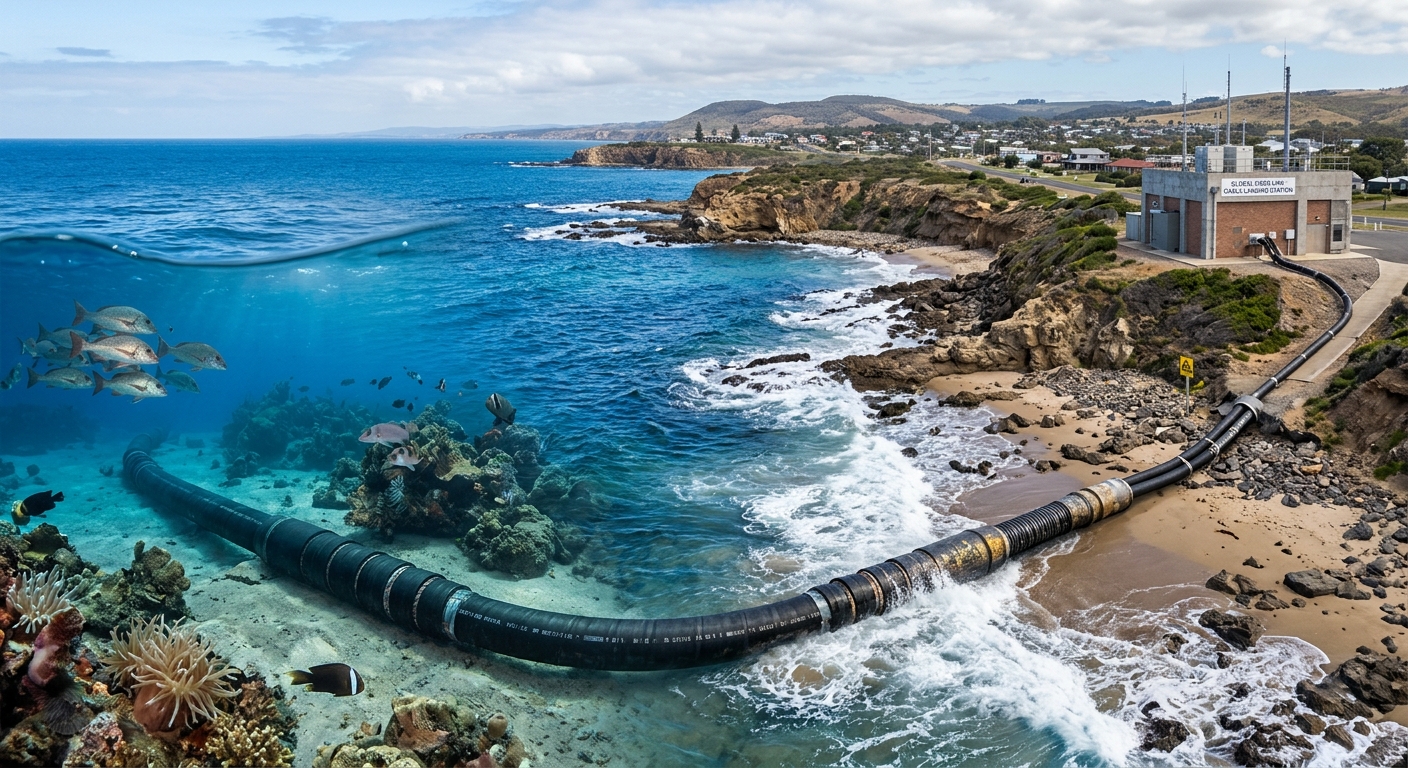
Interception on fiber routes concentrates at landing stations, cabinets, manholes, and repair splices. By bending the fiber cable, a clip-on-coupler can exfiltrate the light from a live fiber without cutting it. OTDR and power monitoring are deployed to detect taps, but such small fractions of light can be leaked, making their measurement indistinguishable from a baseline. Layer 1 encryption makes a captured copy unreadable, but the copy remains storable. Carmel applies photonic layer security so that a tap collects optical noise instead of a recorded signal.
Enterprises protect subsea and terrestrial fiber by finding where the glass can be physically reached, monitoring those points, controlling who can open the cable, and securing the signal itself so that a successful tap collects nothing usable. The Guardian's Tempora reporting, summarized by Al Jazeera, described GCHQ tapping more than 200 fibre-optic cables, and Security Affairs places the probes where transatlantic cables come ashore.
Where taps happen on subsea and terrestrial routes
ENISA reports that more than 97 percent of the world's internet traffic crosses subsea cables at some point. It considers eavesdropping on the open seabed unlikely but access at landing points feasible (SubTel Forum). Recorded Future reaches the same conclusion from the attacker's side. It expects only a few countries can tap deepwater cable without detection and describes landing stations as easier to reach and sometimes less protected (SecurityWeek). The interception risk on a subsea route therefore concentrates at its shore ends.
Terrestrial spans are exposed wherever someone can reach the cable. A clip-on coupler bends a live fiber just enough for a fraction of the light to leak out and be captured, without cutting the cable or causing an outage. Repair work widens the exposure further. In May 2024, the Wall Street Journal reported US warnings that China-controlled repair ships could tamper with Pacific cables (SubTel Forum), an accusation Beijing rejected.
Read to find out how permits and open splices create an exposure window during repair work.
Layering controls by how long the data must stay confidential
Start by ranking every link on how long its traffic must stay confidential, then match the controls to the rank. A stored copy of ten-year duration, highly sensitive contracts is worth far more to an attacker than a copy of month-old billing data, so links that carry the longest-lived, and most sensitive data, justify the most protection. No single control covers every link, because detection tools raise an alarm only after a tap exists.
Every link gets the baseline. That means an inventory of its landing stations, carriers, cabinets, manholes, and the parties who can authorize repair access, plus access control and tamper-evident seals at each point where the cable can be opened and potentially touched.
Mid-ranked links add continuous monitoring, which shortens the time a tap goes unnoticed but has clear limits. A typical OTDR system can reliably detect and locate a discrete loss of about 1 dB, and its alarm threshold is often set near that level. A fiber-bend tap loses about 0.8 dB, which can fall below that threshold. Losses of about 0.1 dB are usually lost in trace noise. OTDR alarms also depend on comparing each trace against a reference trace, so a tap that was already in place early on, when the reference was recorded, is never flagged.
The highest-ranked links add distributed acoustic sensing to flag digging and tampering along the route. These are typically landing-station segments, shared conduit, and spans whose repair authority sits outside the organization. They also need protection at the signal level, because monitoring shortens the time a tap goes unnoticed. However, Layer 1 encryption and photonic layer security address the vulnerability of a tap that goes undetected.
Wondering where detection falls short in practice? We break it down in - Can Fiber Optic Cables Be Tapped, and How Do Enterprises Detect It?
Where encryption stops and photonic layer security starts
Encryption makes a tapped signal unreadable, and adding a post-quantum key exchange closes off the potential of exposure once cryptographically relevant quantum computers are available. However, the payload itself still exists, and its protection depends on the cipher and the key exchange holding for the full time the data must stay confidential.
Unlike encryption, Carmel is focused on protecting what a tap collects, instead of what a tap can eventually unveil. Carmel spreads the optical signal across a wide spectral band, embeds a key that changes every fraction of a second, and buries the result under added optical noise. The authorized receiver reconstructs the data optically in real time, so an observer on the fiber sees noise with no recordable structure. Carmel supports long-distance transmission over standard single-mode fiber on terrestrial and submarine links, and it is easily installed by substituting the transmission line card. A tap at a landing station, a cabinet, or a repair splice therefore collects nothing worth storing.
Carmel does not detect taps and does not stop anyone from installing one, so attackers can continue their attempt to monitor, but the wavelengths they extract are useless. The platform is complementary to post-quantum cryptography and higher-layer encryption. Those still protect the rest of the stack. Carmel protects the link between the two ends where it is installed, so the ranked link list decides where it goes.
Sequencing protection across a mixed estate
Operators with both subsea and terrestrial links apply photonic layer security first to the spans that rank highest on data lifespan and sensitivity. Then, cross shared or third-party access points. Monitoring and access controls stay on every route because they detect intrusion into the cable plant, and encryption stays on as a security baseline.
Carrying traffic that must stay confidential for a decade or more? Visit CyberRidge to review which of your fiber spans warrant harvest-proof protection.
FAQs
Q: Does Carmel work on subsea links as well as terrestrial ones?
A: Our platform supports long-distance transmission over standard single-mode fiber, including terrestrial and submarine links. The protection sits at the physical layer, so the same signal handling applies on both route types. ENISA identifies landing points as the feasible place to access communications data on subsea cables, which is where a captured signal would otherwise be easiest to record (SubTel Forum).
Q: Does Carmel detect or block a fiber tap?
A: No. Carmel does not detect taps and does not prevent their installation. We convert the signal into optical noise on the fiber, so a tap collects nothing recordable, and OTDR or power monitoring remains useful for finding intrusion into the cable plant.
Q: How does Carmel differ from Layer 1 encryption with AES-256?
A: Layer 1 encryptors such as Adtran's ConnectGuard encrypt the data with AES-256 and transmit it as a normal optical signal, which a tap can copy in full. Carmel manipulates the analog optical signal until it is indistinguishable from background optical noise, leaving no raw data or stored keys to intercept. We describe the platform as complementary to higher-layer encryption.
Q: Does Carmel replace post-quantum cryptography?
A: No. Carmel is complementary to post-quantum cryptography and other higher-layer protocols. Post-quantum cryptography protects key exchange, and Carmel addresses the signal that a tap would otherwise record.
Q: How quickly can Carmel be deployed on an existing route?
A: Deployment takes weeks, and Carmel integrates into existing systems without changes to what is already in place. It installs by substituting the transmission line card. Carmel also adds no latency because it processes data in-line without buffering.
Q: Which links should be protected first?
A: We put links that carry long-lived sensitive data and cross shared access points first. The UK NCSC advises organisations to record the data they hold, including its expected lifetime and its value to an adversary. At CyberRidge, we therefore recommend prioritising the services that handle the most valuable, longest-lived data.