

Can Fiber Optic Cables Be Tapped During Repair and Maintenance Work?
Article Highlights
- Repairing a fiber span means cutting the cable and splicing the individual glass fibers back together by hand.
- The splice is the only point in a link's operational life when the individual fibers leave their jacket and are handled directly.
- Repair work proceeds under a permit, so whoever issues that permit holds supervised access to an opened cable.
- A second diverse circuit adds a second set of splice enclosures and a second permitting regime rather than removing the first.
- CyberRidge's Carmel transmits at Layer 1 in a form that cannot be recorded, so a tap installed during a maintenance window captures nothing but optical noise.
A fiber optic cable can be tapped during repair or maintenance work, and the maintenance window is the point in a link's operation when doing so is easiest. Interception scenarios usually assume an attacker working covertly at a street cabinet, under time pressure, with no authority to be there. A repair reverses all three conditions. The cable is deliberately opened, the work runs for days, and the crew doing it is there lawfully. What determines the exposure is who holds the authority to permit, inspect, or supervise that work. Carriers using long-haul WAN infrastructure should be asking the local authorities to name who gets access to an open cable at contract time.
The splice is the moment the fiber is open
A repair starts with fault localization. Reflectometry narrows the break to a segment between two amplifier sites, and a crew then either excavates to the terrestrial splice enclosure or grapples the cable up off the seabed. The damaged section is cut out. Jacketing and armor come off, the glass is cleaved and aligned under a microscope, the ends are fused, and the joint is sealed and tested.
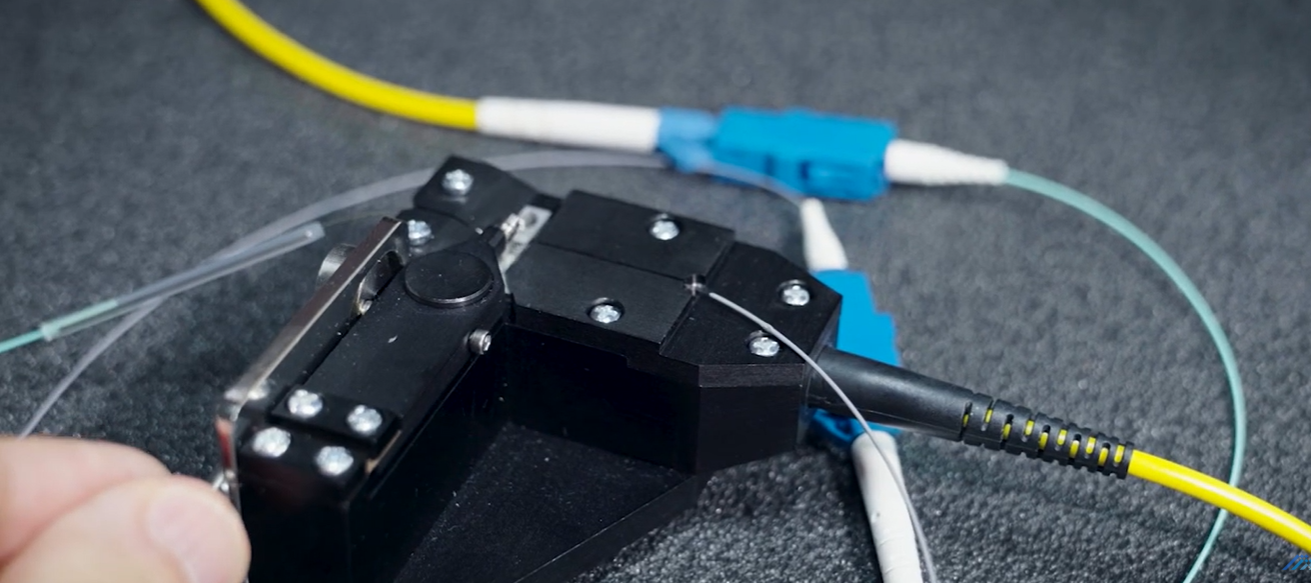
The procedure is the same whether the span runs under a highway or across a seabed. Once armor and jacketing are stripped, the bare glass fibers underneath are exposed, and the fusion splice itself doesn't change with location.
Compare that against the rest of a fiber's life. Traffic runs through sealed, jacketed, buried glass that nobody touches for years at a stretch. During a repair, the individual fibers sit exposed on a bench, handled by people, for a day or more per joint.
Who authorizes access to the cable?
Repairs proceed by permission. A cable operator does not open a span wherever it likes. It opens the span under whatever legal regime governs that stretch of seabed, right-of-way, or conduit, and waits for approval before starting. Jonas Franken told MIT Technology Review that some countries average six weeks to process a repair permit.
Approval carries more than a schedule. An authority that issues permits can attach conditions, inspect the work, and place people alongside it. An attacker forcing entry to a street cabinet gets minutes and leaves evidence. An authority granting the permit gets days at the bench and leaves a paper trail describing routine oversight.
Governments have treated this as a live threat rather than a theoretical one. In May 2024, the Wall Street Journal reported United States warnings to telecom operators that Pacific undersea cables could be vulnerable to tampering by Chinese-controlled repair vessels. Joshua Cole, a Baker Botts partner in Singapore, told AGBI in July 2026 that Iran's newly created Persian Gulf Strait Authority would logically extend its oversight from merchant shipping to the cable repair vessels working beneath the Strait of Hormuz.
Route diversity does not change the exposure
Buying a second circuit fixes availability, not interception. Availability means traffic still moves if one path fails. Interception exposure is a different measure: how many points can data travelling across the fiber be diverted to another, unintended server. A second circuit doesn't lower that count, it raises it. It lengthens the attack surface, compounding the possibility of splice enclosures, a second maintenance contractor, and more identities with access to the cable.
Enterprises are also badly placed to audit any of it. Consortiv reported in June 2026 that most organizations lack complete visibility into how their network services are physically delivered. A diversity guarantee is a commercial commitment. It says nothing about who will be standing over the fiber the next time it comes up for repair.
Wondering what happens to traffic once it has been recorded? What Is Harvest Now, Decrypt Later, and How Can Organizations Protect Against It? explains why a stored copy stays dangerous long after the maintenance window closes.
Where photonic-layer protection applies, and where it does not
Those charged with protecting data traversing fiber optic cables are better off addressing what a tap is worth, rather than preventing one. Photonic-layer protection does exactly that: it secures the waveform on the fiber itself, so the exposure created by a maintenance window doesn't matter. What could get left behind after a repair isn't another splice, it's a coupler. A small device clipped onto the fiber that skims off a fraction of the light without cutting the connection. If that light carries a coherent, recordable signal, the coupler captures it regardless of who supervised the splice.
This is how CyberRidge works. Its photonic layer security spreads the optical signal across a wide spectral band, it embeds a constantly changing optical key inside the transmission, and buries the result beneath amplified spontaneous emission noise. An observer on the fiber hears noise with no recoverable structure. Therefore, a dubious coupler left behind during a repair records nothing worth storing.
For more on how Carmel slots into an existing optical estate, see What Are CyberRidge's Integration and Deployment Options for Unrecordable High-Speed Optical Transmission?
What to establish before the next maintenance window
Ask the carrier which physical routes a circuit follows, whose jurisdiction each route crosses, and who issues the maintenance permits along it. Ask how much notice you get before planned work, and whether you get any notice of unplanned repairs. Most enterprises find the answers thinner than expected, and that thinness is itself the finding. A link where nobody can tell you who authorizes a repair is a link that is susceptible to exploitation.
Carrying traffic that has to stay confidential for a decade or more? Learn more about CyberRidge to work through which of your long-haul spans warrant Layer 1 protection.
FAQs
Q: Does Carmel protect a link while it is physically cut open for repair?
A: No. A span carries no traffic while it is cut, so there is nothing to protect during the cut itself. What Carmel changes is the value of anything left behind: a splitter or coupler installed during that window records optical noise once the link returns to service, rather than a storable copy of the traffic.
Q: Does Carmel detect a fiber tap, or prevent one?
A: Neither, strictly. Carmel does not stop someone installing a tap and does not raise an alert when one appears. It removes the reason to install one, because CyberRidge transforms the data into optical noise that isn’t usable.
Q: Does adding Carmel mean replacing the existing DWDM equipment?
A: No. CyberRidge deploys Carmel as an alien wavelength over third-party DWDM line systems, substituting a transmission line card rather than adding a separate appliance. Existing ROADMs, amplifiers, and transport equipment stay in place.
Q: How does Carmel relate to a post-quantum cryptography migration?
A: Carmel and PQC address different steps. PQC replaces the RSA and elliptic-curve key exchange that a future quantum computer would break, while Carmel addresses the recording step. PQC leaves that step open, because encrypted traffic is still a coherent, storable waveform on the fiber.
Q: How many Carmel units does one protected link require?
A: Two, one at each end of the span. CyberRidge sells and deploys Carmel per link as a matched pair, so an organization protecting several routes scopes the deployment by counting spans rather than sites.